
Foreign investors have largely been exiting one part of the market while domestic investors have been enthusiastically accumulating another, points out Debashis Basu.

Indian benchmark indices, Sensex and Nifty, experienced a significant drop of over 1 per cent, driven by a bearish trend in global markets, weakness in HDFC Bank and IT firms, and fresh foreign fund outflows.

Indian benchmark indices Sensex and Nifty closed largely flat on Monday, recovering from early losses, as escalating tensions in West Asia and a sharp rally in crude oil prices weighed on investor sentiment, despite resilience in IT and consumer durables stocks.

Indian equity markets, including the Sensex and Nifty, experienced a significant downturn for the second consecutive day, driven by escalating geopolitical tensions in West Asia and persistent foreign fund outflows.

Indian stock markets, including the Sensex and Nifty, rebounded significantly, driven by a decline in crude oil prices and positive global cues stemming from hopes of diplomatic progress in US-Iran negotiations.

Amidst a sharp run-up in gold and silver prices, investors are advised to rebalance their portfolios by booking partial profits in precious metals and reallocating to domestic equities and debt, according to financial experts.

Indian benchmark indices Sensex and Nifty saw declines in early trade, influenced by elevated crude oil prices stemming from renewed geopolitical uncertainties, particularly concerns surrounding the Strait of Hormuz. Track Sensex, Nifty on August 11, 2026.

Indian benchmark stock indices, Sensex and Nifty, experienced mixed trading following the introduction of a new Closing Auction Session (CAS) for shares with futures and options (F&O) contracts, aimed at enhancing price discovery transparency. Track Sensex, Nifty on August 4

The Indian equity market is set for an event-heavy week, with analysts pointing to the Reserve Bank of India's (RBI) interest rate decision, developments in the US-Iran situation, and crude oil prices as the primary determinants of market trends.

Indian benchmark indices Sensex and Nifty saw gains in early trade, driven by a decline in crude oil prices due to easing geopolitical tensions in West Asia and strong buying interest in the IT sector.

The combined market valuation of five of India's top-10 most valued firms eroded by Rs 1 lakh crore last week, with IT giant Tata Consultancy Services (TCS) experiencing the largest decline amidst a bearish trend in domestic equities.

Market benchmark indices Sensex and Nifty drifted lower in early trade on Monday amid renewed hostilities between the US and Iran. The 30-share BSE Sensex declined 63.65 points to 77,047.63 during initial trading. The 50-share NSE Nifty went marginally up by 16.55 points to 24,070.20. Later, the BSE benchmark dropped 246.54 points to 76,853.93, and the Nifty dipped 50.55 points to 24,005.45. Track Sensex, Nifty on June 29.
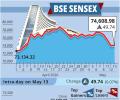
Indian benchmark equity indices, Sensex and Nifty, closed marginally higher, breaking a four-day losing streak, despite elevated crude oil prices and ongoing geopolitical uncertainties. The market saw a temporary pause in panic selling, though cautious sentiment persists.

'Buy on dips, buy on dips and sell on rise.'

Indian equity benchmarks Sensex and Nifty surged nearly 1 per cent, driven by strong earnings reports from FMCG and auto sectors, alongside a rally in Asian markets and signs of de-escalation in geopolitical tensions.
Indian benchmark indices Sensex and Nifty closed lower, with the Sensex dropping 388 points and Nifty declining 112 points, as a sharp rally in crude oil prices, driven by geopolitical uncertainties and concerns over the Strait of Hormuz, dampened investor sentiment and reignited inflation fears.
Indian equity markets experienced a significant decline in early trade, with the BSE Sensex and NSE Nifty dropping, as escalating geopolitical tensions in West Asia and a surge in global oil prices dampened investor sentiment. Track Sensex, Nifty50 movement and key market drivers for May 8, 2026.

Indian benchmark indices, Sensex and Nifty, saw a significant rebound in early trade, with the Sensex jumping 726 points and the Nifty climbing over 200 points, primarily driven by strong performances in IT stocks, HDFC Bank, and renewed foreign fund inflows. Track Sensex, Nifty on July 29.

Shares of HDFC Bank rose nearly 3 per cent after its Managing Director and Chief Executive Sashidhar Jagdishan decided not to seek reappointment after his current term concludes on October 26.
Analysts predict that crude oil prices, geopolitical tensions in West Asia, and upcoming inflation data will be the primary drivers of the Indian stock market this week, alongside foreign investor activity and domestic quarterly earnings.

Indian stock market benchmark indices closed higher, driven by strong performance in blue-chip bank shares and a positive trend in global markets, with hopes of progress in US-Iran peace negotiations also contributing to optimism.

The Indian rupee gained 2 paise to settle at 93.33 against the US dollar, driven by positive sentiment in domestic equity markets and renewed hopes for US-Iran talks, despite rising WPI and CPI inflation.

Indian benchmark indices, Sensex and Nifty, saw early gains driven by lower crude oil prices and buying in Reliance Industries, even as the Reserve Bank of India maintained its benchmark policy rate for the fourth consecutive meeting, reinforcing confidence in the domestic economy.
Indian stock market benchmark indices, Sensex and Nifty, saw significant gains in early trade, driven by a sharp decline in crude oil prices and easing geopolitical tensions, alongside renewed foreign fund inflows.

Foreign Portfolio Investors (FPIs) withdrew Rs 49,340 crore (USD 5.16 billion) from Indian equities in June, driven by global risk aversion, a preference for developed markets, soaring US bond yields, and stretched domestic valuations, bringing total withdrawals to Rs 2.7 lakh crore so far in 2026.

Analysts predict that the Reserve Bank of India's interest rate decision, the evolving situation in West Asia involving the US-Iran conflict, and crude oil prices will be the primary factors influencing investor sentiment in the Indian stock market this week.
Indian benchmark indices, Sensex and Nifty, opened higher on Friday, primarily driven by a significant surge in Bajaj Finance shares following its strong Q1 FY27 earnings report, coupled with continued foreign fund inflows and a dip in crude oil prices. Track Sensex, Nifty on July 31.

Indian benchmark indices Sensex and Nifty experienced a downturn in early trade, primarily influenced by a dip in HDFC Bank shares, persistent outflows from foreign funds, and escalating geopolitical tensions between the US and Iran. Track Sensex, Nifty performance.

Flexi-cap mutual fund schemes have attracted nearly Rs 50,000 crore in net inflows during January-July 2026, a 27 per cent increase year-on-year, as investors increasingly favour dynamic equity strategies.

Indian benchmark indices, Sensex and Nifty, closed lower, primarily due to a downturn in banking and financial stocks, coupled with crude oil prices remaining above USD 80 per barrel. Geopolitical uncertainties and new regulatory proposals for the non-bank lending sector also contributed to cautious investor sentiment.
Indian benchmark stock indices, Sensex and Nifty, recorded their fourth consecutive day of declines, driven by selling in FMCG, financial, and auto sectors. The downturn is attributed to fresh tensions in the Middle East, uncertainty surrounding the US-Iran 60-day ceasefire, and elevated crude oil prices.

Indian benchmark equity indices Sensex and Nifty closed higher, recovering from previous losses, driven by a global market rebound, a pause in Israel-Iran hostilities, and a rally in bank stocks.

'While investors need to be prepared for making some losses, they should not lose big money chasing euphoria amid fear of missing out.'

The Reserve Bank of India (RBI) maintained its key policy rates for the fourth consecutive time, keeping the repo rate at 5.25 per cent, while the benchmark BSE Sensex closed 152 points higher in a volatile session, recovering from an intraday dip.

Indian benchmark indices, Sensex and Nifty, experienced declines in early trade due to a significant surge in crude oil prices, exacerbated by escalating tensions in the West Asia. Track how Sensex, Nifty fared on July 23.

Jio Platforms Ltd, the digital services arm of Reliance Industries, has secured Sebi's final observation to launch an initial public offering (IPO) aiming to raise approximately USD 4 billion (Rs 37,700 crore), potentially making it the largest IPO in India's history.

Shares of temperature sensing and heating solutions provider Tempsens Instruments (India) Ltd listed with a massive premium of over 111 per cent against its issue price of Rs 300, reaching a market valuation of Rs 4,934.81 crore.
If India does get $100 billion a year in FDI, it would be a game-changer in every possible way. FPIs would come rushing back, AI or no AI, points out Debashis Basu.
Indian stock markets closed lower due to selling in IT and FMCG shares, triggered by renewed tensions in West Asia which led to a rally in crude oil prices and concerns over inflation and interest rates.
Indian benchmark indices Sensex and Nifty experienced a significant decline in early trade, with the Sensex falling over 500 points and the Nifty over 150 points, as Brent crude oil prices surged past USD 100 per barrel due to escalating geopolitical tensions in the West Asia. track sensex, Nifty on July 24.
